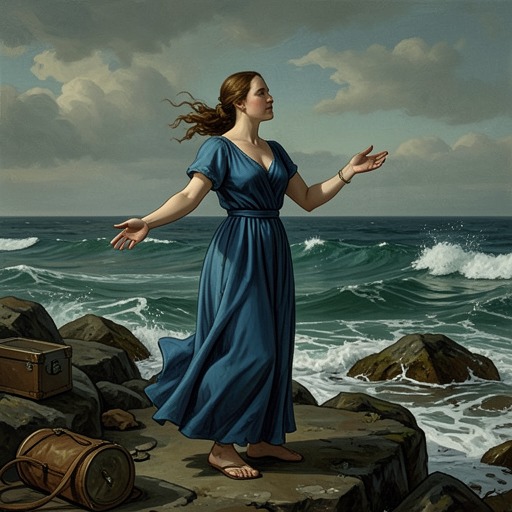
“We gave them songs, they gave us stories”
The Moon and the Sun“We gave them songs, they gave us stories” is the Sea Woman’s account of friendship as an exchange between peoples: neither side simply takes or translates the other’s gift. In her history of the first meeting between sea people and people of the land, songs and stories make a shared world possible. The destruction of Atlantis then gives the phrase a tragic edge: the exchange begins in curiosity and hospitality, but the Sea Woman’s first story of contact also ends in loss.
Origin in the Sea Woman’s History
The phrase occurs while the Sea Woman sings a history rather than her own life story. Marie-Josèphe de la Croix tries to describe the images that emerge, aware that her words are inadequate to what the song conveys. The account begins with the Sea Woman’s dating of the encounter: “Four hundreds and three thousands of years ago, the people of the sea first met the people of the land.” That vast span places the relationship in an ancient past, but the scene itself is rendered through particular gestures of mutual approach.
The ship carries painted octopuses and fish. Sea people watch it with curiosity rather than fear; young people from the ship cast off their short belted kilts and dive into the water to meet them. The two groups play and sing together. The Sea Woman’s summary of their relation is not a claim that they are alike, but that each offers something the other can receive: “We gave them songs, they gave us stories, that cannot be taken, only given. We met as friends.” The distinction between giving and taking makes the exchange central to the expression. Its ideal is encounter without conquest or possession.
Hospitality and the Lost City
The memory continues from the first meeting to a shared journey. The sea people accompany the ship to an island in the Mediterranean, where a harbor and a stone palace spread beneath a cliff. Women greet the visitors at the water’s edge; children throw flowers into the sea, and the sea people weave the blossoms into their hair. In Atlantis’s chief city, the groups ride together in pools painted with dolphins and squids and exchange shells and flowers. The images give the verbal exchange of songs and stories a material counterpart: welcome is enacted through shared movement and objects.
The song’s change in tone breaks this scene of hospitality. Its melody darkens, and an immense explosion shakes the island. Hot wind, burning cinders, and molten stones fall across the city; ash rolls over the sea people’s chariots. After the eruption, the city is destroyed. The Sea Woman sings that her people searched for their friends and never saw them again. They were the first of her people to perish through meeting the people of the land. The phrase’s affirmation of friendship therefore does not erase the cost of contact: the same history that remembers reciprocal gifts also records the loss that followed.
Telling, Omission, and Witness
When the Sea Woman’s song reaches this point, Marie-Josèphe falls silent. She ends her spoken account with the sea people still accepting flowers in the lost city, telling the visitors, “That is all.” They applaud, but the Sea Woman snarls and splashes her angrily, demanding an explanation. Marie-Josèphe asks, “How could I tell them — ?” The scene sets two forms of transmission against each other: the Sea Woman sings a history whose catastrophe is integral to its meaning, while Marie-Josèphe’s spoken rendering stops before that loss reaches the audience.
The moment makes the phrase more than a statement about an ancient exchange. It also draws attention to the difficulty of carrying another people’s story across a divide in language and audience. Marie-Josèphe can convey the images only inadequately, and her chosen stopping point leaves the visitors with a vision of welcome rather than the destruction that followed. The Sea Woman’s anger establishes that this omission matters to her; the exchange of stories, like the exchange of songs, requires attention to what is given and what is left unsaid.
Material Gifts and the Courtly Counterpoint
Elsewhere, the novel places the Sea Woman’s language of freely given cultural gifts beside exchanges shaped by money and rank. After the King departs, Lucien de Barenton, Count de Chrétien gives the galleon’s captain a small, heavy leather sack. The captain pours out gold coins commemorating Louis XIV and laughs with delight; for a man of his station, the handful of louis d’or is a fortune. The captain calls after the King with thanks, even naming him a royal jester. Here a gift is also a display of royal favor, its value measured in gold and in the difference between the giver’s power and the recipient’s station.
At the dissection table, Lucien offers Yves de la Croix a sack twice the size of the captain’s purse, carrying the King’s regard. Yves refuses it, explaining that the King saved his sister from the war in Martinique and gave him the means to advance his work; he asks for nothing else. Marie-Josèphe steps between the men and accepts the purse from Lucien. The exchange turns on different responses to royal benefaction: Yves declines further payment, while Marie-Josèphe takes the heavy gold. Her fingertips brush Lucien’s glove, which he withdraws without acknowledging the touch. The scene makes material reward, gratitude, and personal feeling distinct rather than interchangeable.
A later letter brings another kind of exchange into view: Lucien opens Marie-Josèphe’s letter to Louis XIV, which says that Sherzad offers a great treasure ship as ransom. The treasure is offered in return for a life, not as the open-ended sharing described in the Sea Woman’s song. At the royal banquet in the Hall of Mirrors, by contrast, music, orange trees, elaborate seating, and months of preparation frame a courtly spectacle of abundance and precedence; Marie-Josèphe enters alone, under guard, as aristocrats speculate. Together these scenes sharpen the expression’s significance. The novel places reciprocal cultural gifts beside transactions and royal rewards, distinguishing friendship’s exchange from the unequal bargains and ceremonies that govern the court.